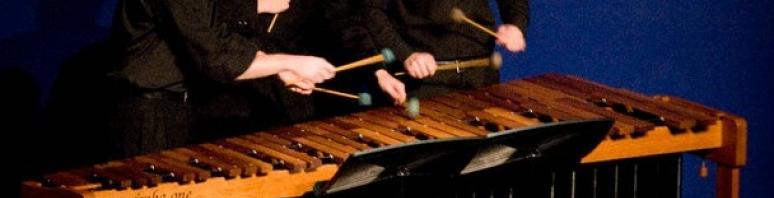
General information/expectations regarding Percussion Lessons
High-intensity, high-impact, and high-energy lessons are what you need to expect when you walk into a lesson with BK. Your lesson time can be likened to having a personal trainer at the gym - You are gonna get your butt kicked and you might come out a little sore by the end of it (physically AND mentally)! But don't let this scare you --- This is want you want in order to improve your technical abilities at a faster rate and gain a sharper knowledge about what it is to be a highly successful musician!
In order to achieve the best possible results, however, you too must BRING IT! That means steady practice away from your weekly lessons - which is where you apply your new knowledge and ideas and build upon them through your own realizations and self-discoveries. If you rely on the short bit of time you get each week with BK to give you serious results without putting anything else into it, then, much like having a personal trainer but never going to the gym on your own, your music lessons will be virtually wasted! But, if you truly apply yourself, then the sky is the limit for what you will be able to achieve!
So, if you are all about having a great deal of fun, learning a ton about music and being a musician, and gaining a level of self-discipline and mastery like never before, then lessons with BK are for you!
Lessons at your school
This is the best option for those who prefer or need the convenience of having their lesson at school, either during their band/percussion class or before/after school. Lessons last for one-half (or one-third a period for 90-minute block scheduled schools) a school period. Due to the very limited amount of time (25-30 minutes), we will typically only cover one instrument a week (snare, marimba/vibraphone, timpani, etc). Much like home studio lessons, we will begin each school lesson with "technical studies," so that each student is always being pushed to improve upon their current level of ability on each instrument. We will then quickly progress to the music at hand and identify as many problem spots as possible. Realize that, in most case, we won't typically solve the issues we identify throughout a lesson. That's called HOMEWORK! It is the student's responsibility to fix the problems that are addressed in lessons in their daily practice sessions, using the strategies discussed in the lesson regarding how to solve or conquer the issue. We will then check on that progress at the beginning of the next lesson and continue to build upon that.
The tuition rate for in-school lessons is district-mandated and can be found on your school's music lesson website ($22 per half-period lesson).
Pre-6th grade students who hope to be accepted into their middle school's percussion class
As there is almost always a huge number of young students wishing to join the beginning percussion class in 6th/7th grade, gaining one of those coveted spots continues to be highly competitive. One of the best ways to give your child an edge is to enroll them in beginning percussion lessons. These lessons cover the basics of percussion, starting with snare drumming, and are specifically geared towards preparing your child to be at the top of the pile when it comes time for the band directors to select their newest percussionists.
NOTE: While it certainly gives your child an advantage, having taken percussion lessons prior to your school's selection process does NOT guarantee acceptance into the beginning percussion class.
Further recommendation: You should also seriously consider enrolling your child in piano lessons, which is very commonly a decisive factor in the selection process. It is common knowledge that students with piano training tend to make more well-rounded percussionists!
The Benefits of Music Education
Over the last several years, there have been countless studies that have established, beyond reasonable dispute, the value of a strong musical education in people's lives - better test scores in school, improved motor skills, higher self-esteem - but there's perhaps an even more fundamental reason for pursuing a music education that is not as commonly talked about. Music, and all of the arts, teach something that is not nearly as readily conveyed in other areas of educational study --- Music teaches us about AESTHETICS.
Aesthetics - the area of philosophy regarding the nature of what we human beings find beautiful in the world - is the quintessential aspect of our humanity that defines us as human beings. It is because of aesthetics that we can appreciate a brilliantly written novel, why we love a majestic mountain landscape, and how we can have a strong interest in learning about other cultures of the world. Those of us who have grown up with this wonderful influence being actively nurtured throughout our lives tend to be the ones who are more proactive in preserving this beautiful world and doing more to make it a better place for all of humankind. But aesthetics is not a passive or tacit knowledge. In order to have a truly deep appreciation for the world around us, we must be well learned so that we can question and be critical of that which we experience throughout our lives, so that our thoughts and opinions are well informed and insightful.
The National Standard of Music Education
1. Singing, alone and with others, a varied repertoire of music.
2. Performing on instruments, alone and with others, a varied repertoire of music.
3. Improvising melodies, variations, and accompaniments.
4. Composing and arranging music within specified guidelines.
5. Reading and notating music.
6. Listening to, analyzing, and describing music.
7. Evaluating music and music performances.
8. Understanding relationships between music, the other arts, and disciplines outside the arts.
9. Understanding music in relation to history and culture.